
Sacramento People Directory Landscape
The most useful Sacramento people directories are kept by different institutions. A school district can confirm a staff member's title and department. City pages identify elected officials, commissioners, and executive leaders. County indexes list parties to recorded documents or owners on the secured assessment roll, though the web access rules differ. State systems cover licensed professionals, businesses, and personnel contacts. Historical collections then extend a search across more than a century of city growth.
| Directory source | People or parties listed | Keeper | How to consult it |
|---|---|---|---|
| SCUSD staff directory | District educators and staff | Sacramento City Unified School District | Free web search |
| College and campus directories | Faculty, staff, administrators, departments | Los Rios colleges and Sacramento State | Free web search |
| Public official rosters | Elected leaders, appointees, department heads | City, county, and state agencies | Agency pages and organization charts |
| Recorded Documents Search | Parties named on deeds, liens, and related filings | Sacramento County Clerk/Recorder | Free index from 1849; images require another access route |
| Assessment roll | Secured-property owners and mailing addresses | Sacramento County Assessor | Lobby computers or limited address/APN requests |
| Professional license search | People and firms licensed by California boards | California licensing agencies | Free state portals |
| City and phone directories | Past residents, firms, spouses, occupations, addresses | Center for Sacramento History and Sacramento Room | Digital search, finding aid, or archive visit |
Start with the directory closest to the person's role. Current public work is best checked through an agency or campus listing. A property or filing calls for a county index. An old address belongs in a reverse directory, while a trade or regulated service belongs in a state license database. These official routes also show what the record keeper chose to publish, instead of blending unrelated names from many places.
Sacramento School Staff Directory
The Sacramento City Unified School District directory is one of the clearest local staff tools. Its inspected special-education directory displayed 532 constituents and allowed a broad keyword or a first-and-last-name search. Results identify the person within a work setting, which helps distinguish two people with similar names. A title, location, and department can be more useful than a bare phone listing.
| Search field | Input type | Required | How it narrows the directory |
|---|---|---|---|
| Keyword | Text | No | Searches the directory with free text |
| First Name | Text | No | Filters by a staff member's first name |
| Last Name | Text | No | Filters by a staff member's last name |
| Pagination | Page controls | Not applicable | Moves through numbered result pages |
The inspected sample entry shows how the result fields work together. It identifies a specific person and then supplies enough institutional context to separate that person from others with a similar name.
- Name: Kathleen Abendroth
- Title: Lang. Speech & Hearing Speclst.
- Location: District Office
- Department: Special Education
- Email: Field present and may be displayed as a link
The SCUSD staff directory shows the live filters and result layout.
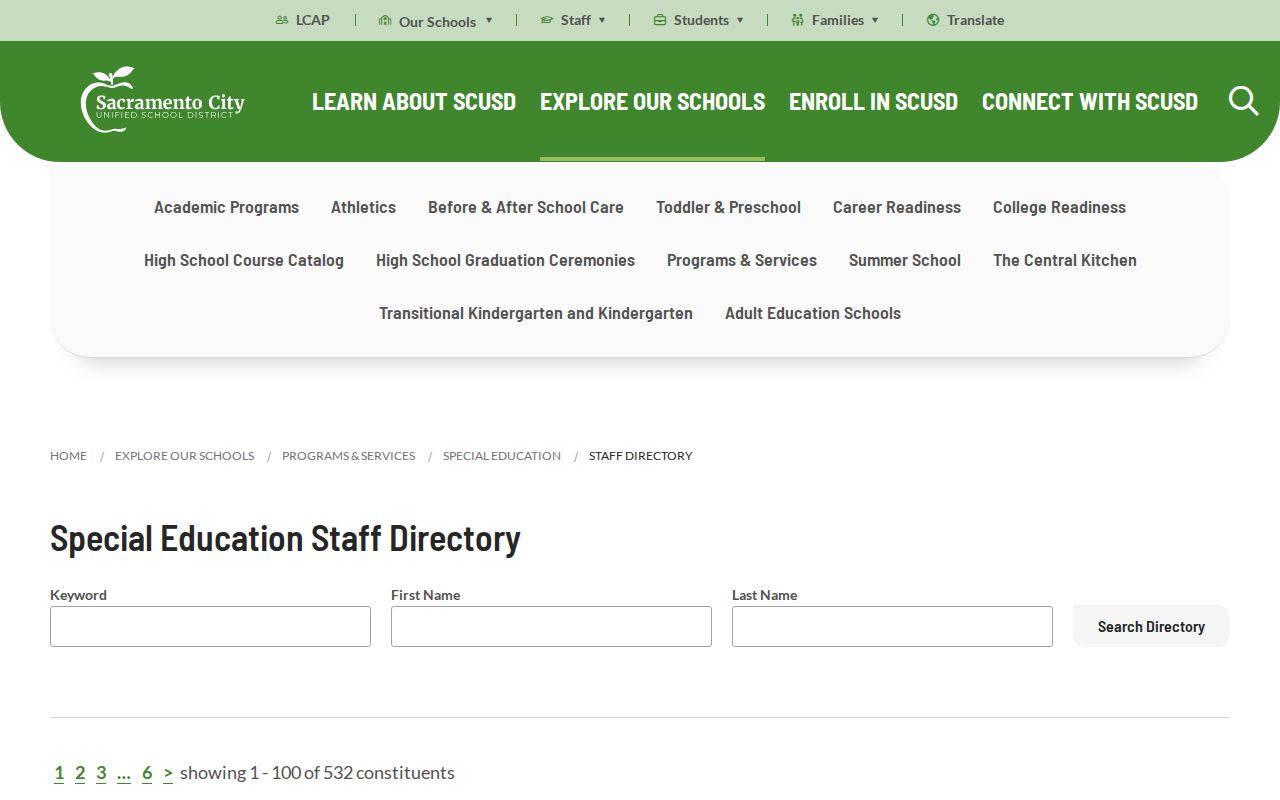
The captured page confirms that the district supports both name-specific and broad keyword searches rather than offering only a static office list.
Sacramento College Directory Paths
Higher education adds two distinct Sacramento directory routes. The Los Rios system and Sacramento City College publish an employee directory for faculty, staff, and administrators. Sacramento State's campus directory accepts first name, last name, or department name, then filters results by All, Staff, or Faculty. The university's faculty catalog can add appointment year, academic title or department, and degree information.
Use a department search when the spelling of a name is uncertain. It creates a short roster of people tied to the same program or unit and can expose the preferred form of a name. The campus directory is current-work evidence, while an older yearbook or faculty catalog may be better for a past affiliation.
The Sacramento City College employee directory is the source for the Los Rios listing shown here.
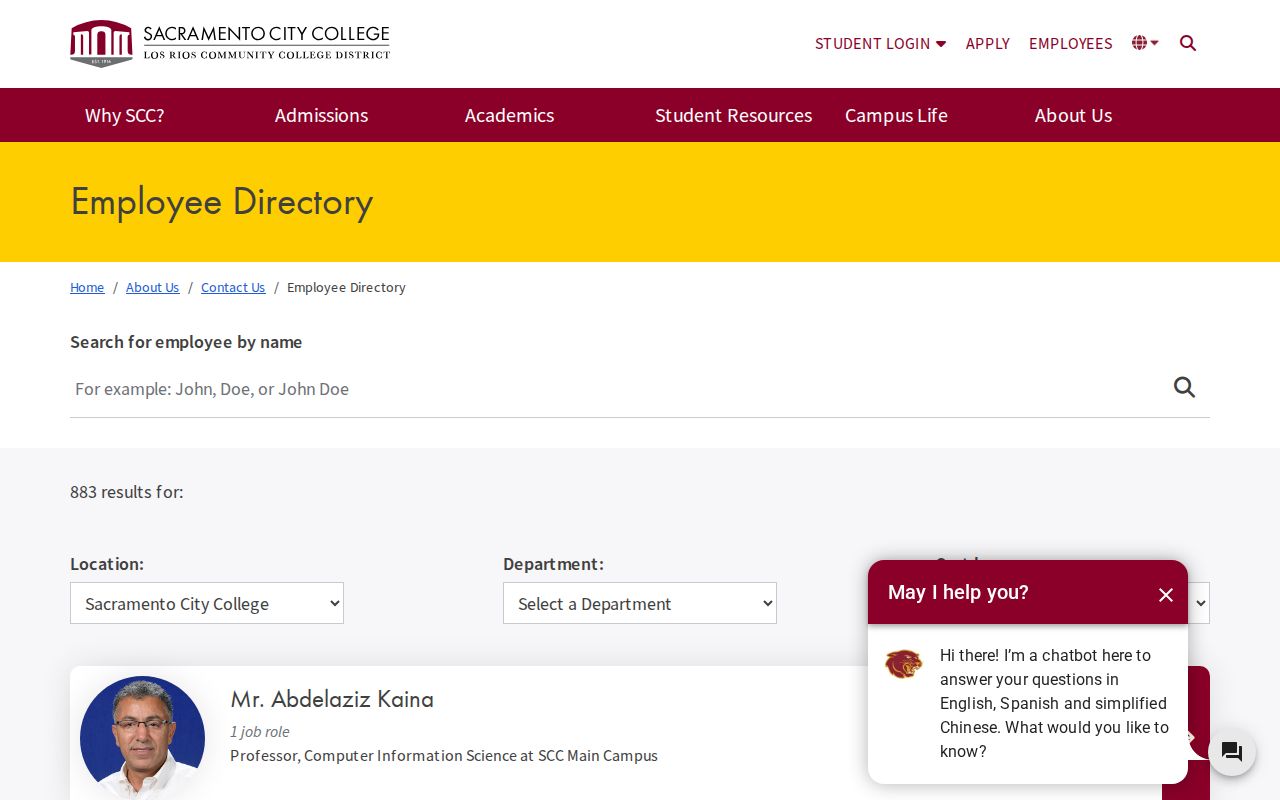
This directory gives Sacramento researchers a direct institutional route for current college employees without turning to a broad commercial listing.
Note: Staff lists change as roles shift, so confirm a current title with the institution before relying on an older saved result.
Sacramento Government Directory Routes
Sacramento is a city, a county seat, and California's capital. As a result, a government directory search must begin with the right layer. City pages list the mayor and council, boards and commissions, the executive team, and departments. County offices publish elected officials and department contacts. At the state level, the California Personnel Office Directory lists personnel staff, work phone and email, department street and mailing addresses, and agency codes.
The city does not expose one verified, comprehensive employee-search interface in the research set. Its records and department directory is the practical starting point. Follow the named department, official roster, executive page, or organization chart. If a staff name is absent, call the department's main line. A records request is the last route when an identifiable public roster exists but is not posted. The full request rules belong with Sacramento public records access, not with a staff-directory lookup.
Use directory details lawfully. Public work contacts are meant for civic communication and research, never stalking, harassment, threats, or harm.
Sacramento Permit Directory Searches
The City of Sacramento Public Permit Portal works as an address and professional directory even though it is organized around projects. Its home screen divides records into Building, Planning, Operating Permit, and General Property Info. The city says users can view permit details, check status, and pay fees. Some functions require an account. Portal help falls back to 311 within the city or the published outside-city service number.
The City of Sacramento permit portal supplies the main route into those modules.
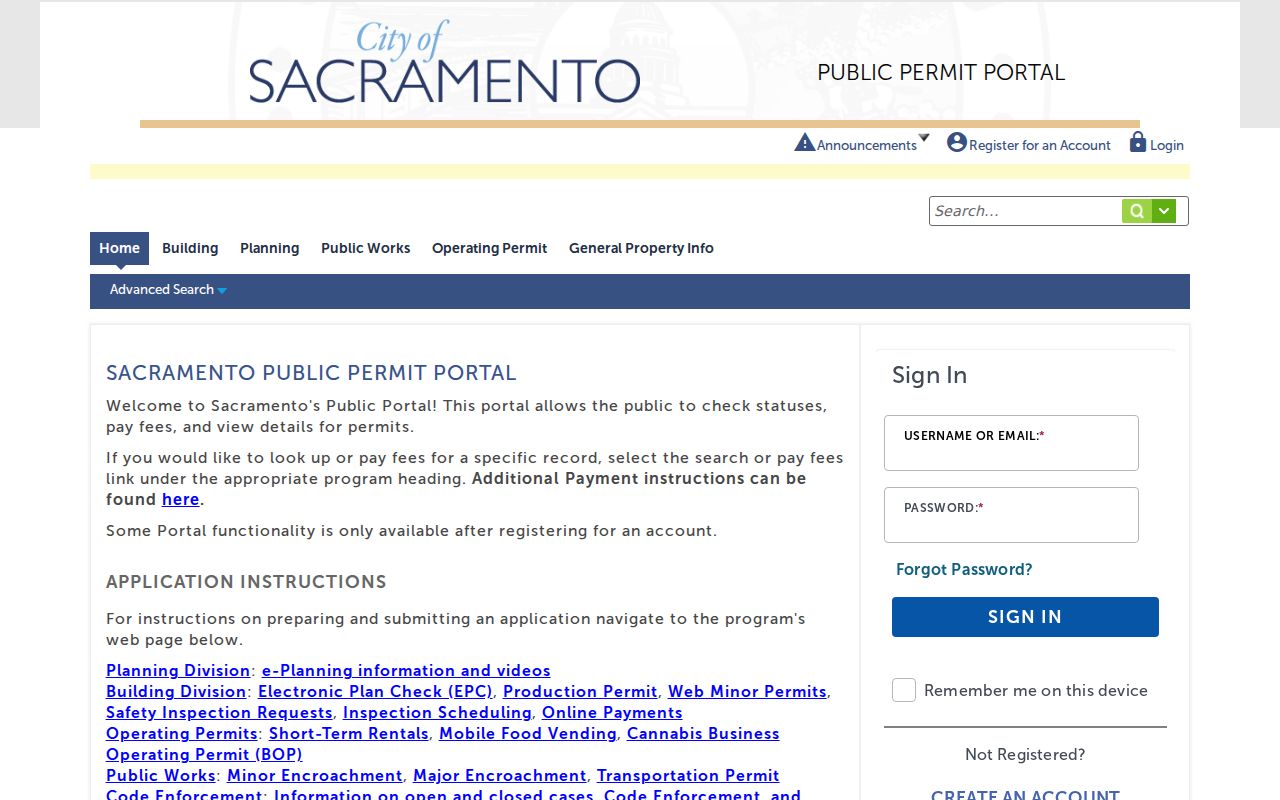
The portal landing page shows why a user must select the record class before searching for a person, license, parcel, or project.
The building module is more precise. It can connect a site or parcel to a permit number and contractor license.
| Building search field | Format | Directory use |
|---|---|---|
| Permit Number | Text | Opens a known permit or active application |
| Site Address | Address | Finds records tied to the project location |
| Parcel Number | APN text | Links a county parcel identifier to city work |
| Contractor License | Text | Connects permit records with a licensed professional |
The Sacramento building permit search displays those fields on one form.
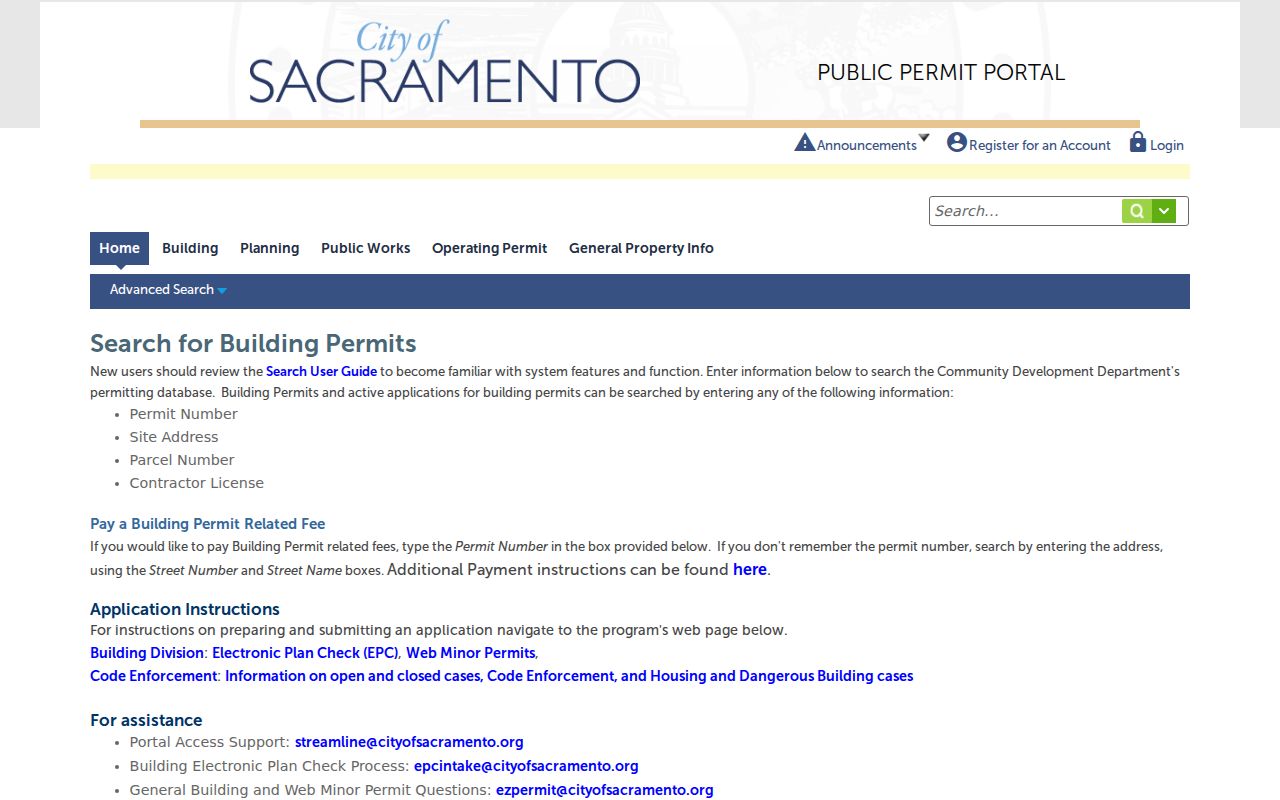
The screenshot confirms that an address, APN, or contractor license can provide an alternate entry when the permit number is unknown.
Sacramento Code Case Directory
Code enforcement records form a smaller address directory. Sacramento's search covers current and closed cases within city limits and accepts a case number or address. It does not begin with a person's name. Instead, it establishes whether a city code case is linked to a place, after which the parcel and recorded-document directories can supply more context.
The Sacramento code case search page explains the scope and sends users to the case system.
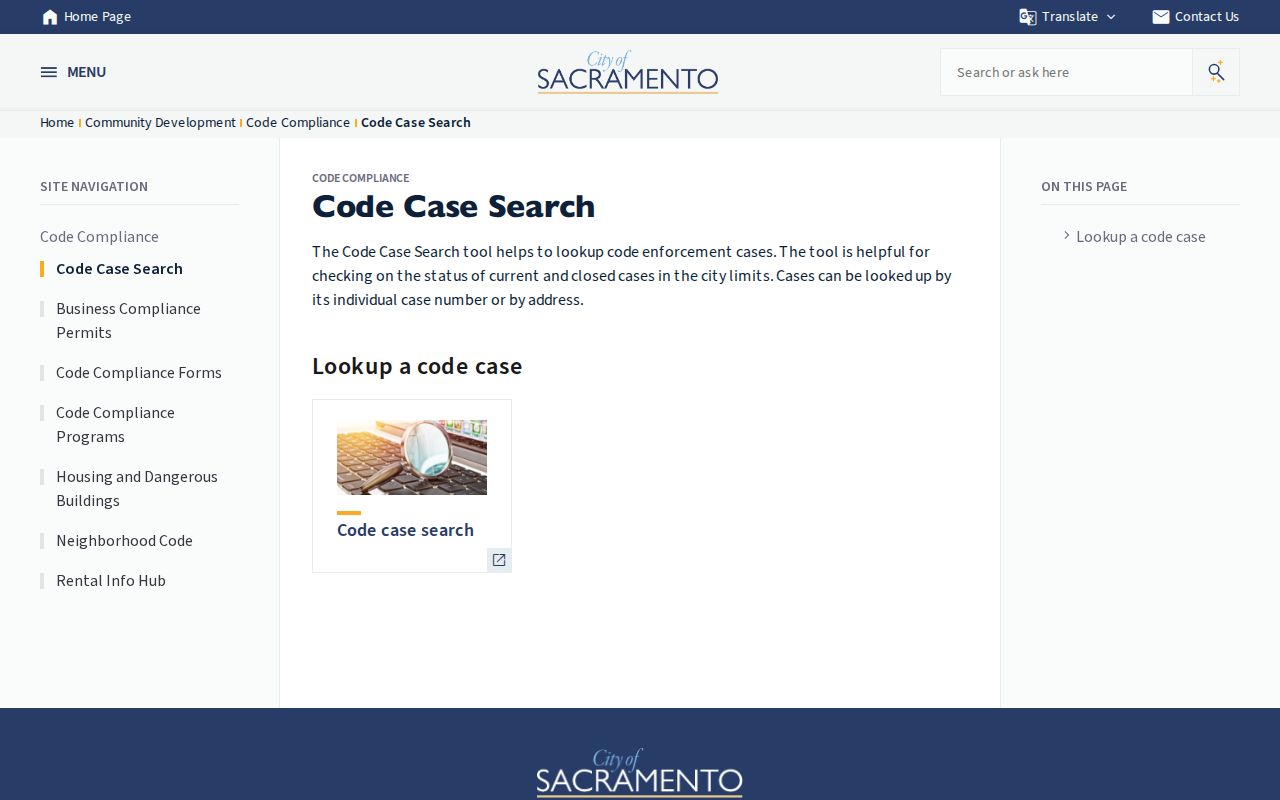
The source page makes the city-limit rule important: a Sacramento postal address may lie outside the City of Sacramento and belong with a county route instead.
Sacramento Record-Based Directories
Two Sacramento County records systems behave like people directories. The Clerk/Recorder index searches parties named on deeds, deeds of trust, reconveyances, assignments, liens, and other instruments recorded since 1849. It can accept names, document type, date range, document number, APN, and book/page details. The index identifies the filing, but it does not display the actual instrument image. Copies or certified copies must be obtained through the Clerk/Recorder's ordering or office channels.
The Recorded Documents Search is therefore a deep name index, not a full document library. A grantor is a party giving or transferring an interest; a grantee receives it. Those roles help separate a seller from a buyer when names appear on a deed.
The Assessor's roll works in the opposite direction. The web Parcel Viewer reveals address, APN, values, land and building facts, jurisdiction, and the most recent transfer document number, but it withholds the assessee name online. Secured ownership can be requested by phone or email for up to two parcels per day when the address or APN is supplied. Full public ownership data is available at lobby computers. The Assessor ownership information page explains those routes.
- APN
- The Assessor Parcel Number, a code that identifies a parcel.
- Situs address
- The physical location of the parcel, which may differ from the owner's mailing address.
- Jurisdiction
- The city or unincorporated area that governs the parcel, separate from its postal city.
- Recorded instrument
- A deed, lien, map, or other document accepted into the county's official record.
Note: Sacramento mailing addresses do not always mark city jurisdiction; check the Parcel Viewer's separate Postal City and Jurisdiction fields first.
Sacramento Professional Directory Checks
California's state databases are local directory tools for Sacramento because they cover people and firms working in the capital. The Department of Consumer Affairs search accepts first name, last name, license number, business name, board or bureau, and license type. Results can verify whether a covered license is current or expired and may show discipline such as suspension or revocation.
The DCA advanced license directory is the broad professional route. Contractor records can also be checked by license number, business name, contractor first and last name, or home-improvement salesperson registration. City permit results may provide the contractor license that unlocks that second search.
Business and filing directories add another layer. The Secretary of State's bizfile search hub links business, trademark, Uniform Commercial Code, certified-copy verification, and other state searches. Uniform Commercial Code records can be searched by debtor name, secured-party name, or file number. The state also issues a business-day notary listing with notary name, business name, mailing address, filing county code, commission number, and expiration date.
Sacramento Library Directory Holdings
The Center for Sacramento History is the official archive for both the city and county. Its public records begin in 1849, and its wider collections include personal papers, business records, photographs, film, and objects. The archive's online catalog has keyword, advanced, archive, photo, library, and object searches across more than 75,000 entries. Results can show a catalog number, collection, title, description, date or year range, place, subjects, and search terms.
City Directories
Years: 1850 through the early 1990s
Entries may give a name, home or business address, occupation, work address, and spouse. Use the finding aid, digital collection, or archive.
Phone Books
Years: 1967 to present
Resident and firm listings may include an address and phone number. Consult the digital collection or archive volumes.
Reverse Sections
Years: From 1914
Street-order pages identify an occupant from a known address. Browse the reverse section in the relevant directory volume.
Sacramento Room
Years: Vary by collection
Special collections include yearbooks, maps, photographs, city and county histories, and genealogy databases with older records.
The Center for Sacramento History collections page is the route for archive research and reproduction requests. The Sacramento Public Library also provides Ancestry Library Edition for use inside a library, while HeritageQuest and the newspaper collection are available with a library card. These are fallback paths when a name is missing from a current portal or the needed volume is not on the open web.
Historical Sacramento Directory Timeline
Sacramento's directory era began almost as early as its official public record. The long run supports two kinds of research. Alphabetical listings move from a name to an address, trade, spouse, or phone. Reverse sections move from an address to an occupant. That second method is valuable for family history, reunions, and the study of a home's past.
- 1849: The Center for Sacramento History's public-record holdings begin, matching the starting year stated for the county recorder's online index.
- 1850: The Sacramento area city-directory collection begins. Early entries may even note where a person came from.
- 1914: Reverse street sections begin appearing, turning known addresses into occupant searches.
- 1967: The collection's continuing phone-book run begins.
- Early 1990s: The main historical city-directory series reaches its stated endpoint, while phone books continue.
The Sacramento Room Digital Collections offers full-text searching across digitized telephone books and city directories for residents, firms, and government agencies. If optical text recognition misses an old spelling, browse the page images near the expected alphabetical spot. For an old address, inspect the reverse section after 1914, then compare nearby years to learn when an occupant first appears or leaves.
This dual name-and-address design is Sacramento's key directory quirk. It turns a set of old books into a year-by-year record of who lived and worked along a street, while the archive and library routes preserve access beyond what a modern web index can show.